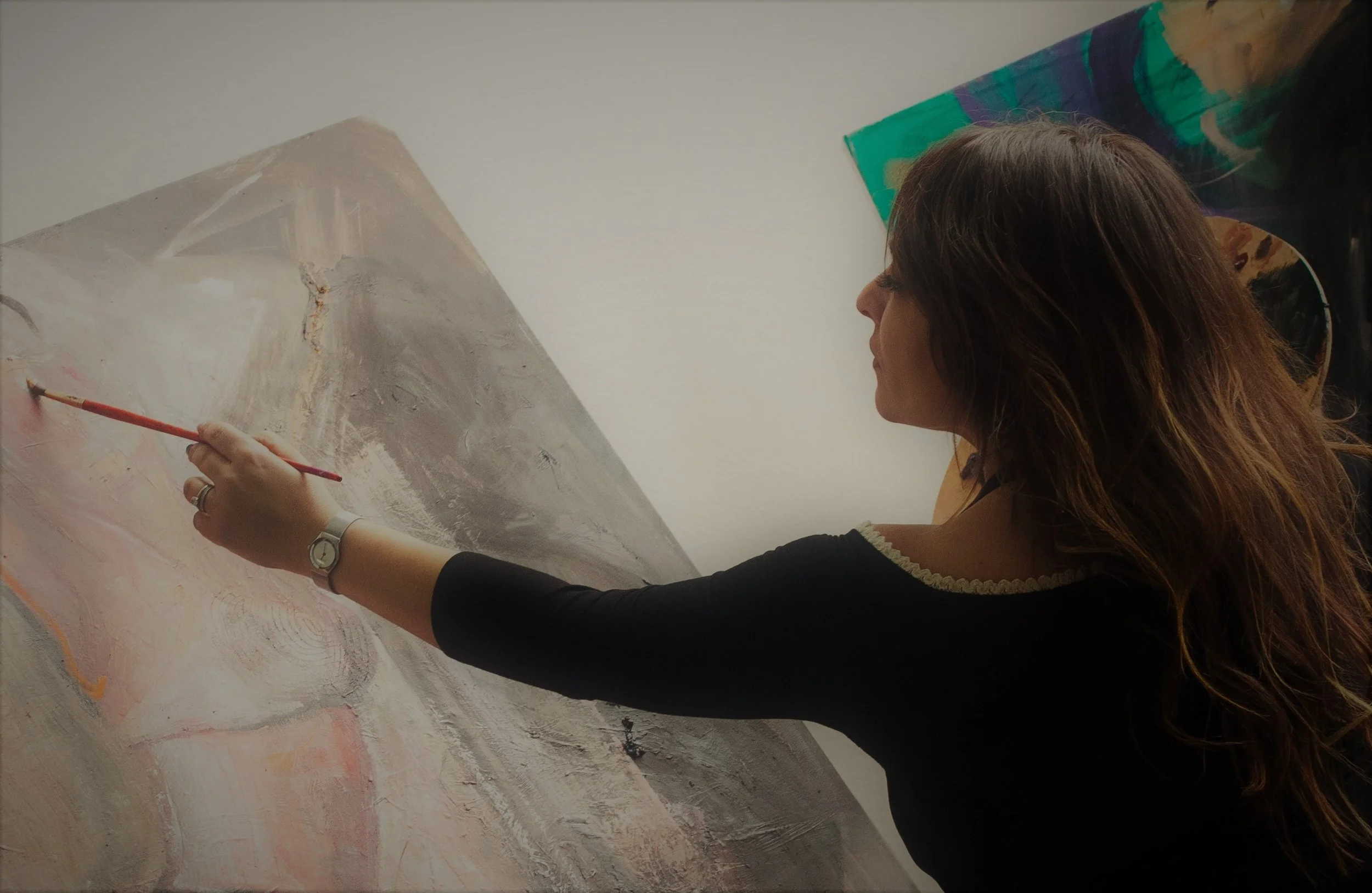
Bio
Elissa Lieberman (b. 1975, Columbus, OH) is a figurative painter whose work explores portraiture as a site of psychological presence, identity and human connection. Working between observation and invention, her paintings examine the expressive potential of the human form, the narrative tensions inherent in contemporary existence, and the complex relationship between artist, subject and representation.
Lieberman earned a BFA from the Columbus College of Art & Design before receiving her MFA from the Maryland Institute College of Art's Hoffberger School of Painting, where she studied under Abstract Expressionist Grace Hartigan. Lieberman’s practice draws from the traditions of Renaissance painting, German Expressionism, and contemporary figurative art while remaining rooted in close observation and emotional immediacy.
Alongside her studio practice, Lieberman has built a distinguished career as an educator. She has taught at institutions including San Diego State University, the University of San Diego, Southwestern College, Mesa College, the Delaware College of Art and Design, and the La Jolla Athenaeum. In 2015, she founded the San Diego Art Loft, an influential community studio that became a gathering place for figurative artists and life drawing before closing in 2020.
Following a transformative return to painting, Lieberman relocated to New York City in 2026, where she maintains a studio in Chelsea. Her current body of work reflects a renewed commitment to paintings that investigate resilience, vulnerability, and the stories carried within the human figure.
She lives and works in New York.
Statement
My work centers on figurative painting. While my early work consisted of large-scale narrative and allegorical paintings influenced by my passion for art history, my practice has increasingly focused on the human form, treating faces and figures as sites of psychological presence rather than simple likeness.
Working with restrained, layered paint and subtractive marks, I reveal the luminosity of the canvas through transparent grounds, wipe-outs, scraping, and lifting paint back. I prioritize structure, pressure, and immediacy over narrative description. The recent faces emerge from darkness as psychological presences, allowing ambiguity and intensity to coexist without full resolution. They seem less painted than uncovered, as though released from the surface itself.
I often work with alternative tools rather than brushes, allowing the process to become more physical and expressive. Removing paint can be as important as applying it. Whether working in oil, charcoal, or mixed media, I am interested in excavation rather than description, revealing an image rather than constructing one.
I have always moved between narrative and the face, feeling pressured to choose. I no longer see them as separate. The face carries the narrative. It is only a matter of cropping. As my practice continues to evolve, I am returning to larger narrative works that build upon the same concerns with psychological presence, memory and human experience.
As writer Maurice Taplinger observed, my paintings possess an "epic quality," investing "the canvas with its own peculiar poetry" as "a convincing conjurer of dark personal myths." That search for images that carry both mystery and emotional truth continues to guide my work.